
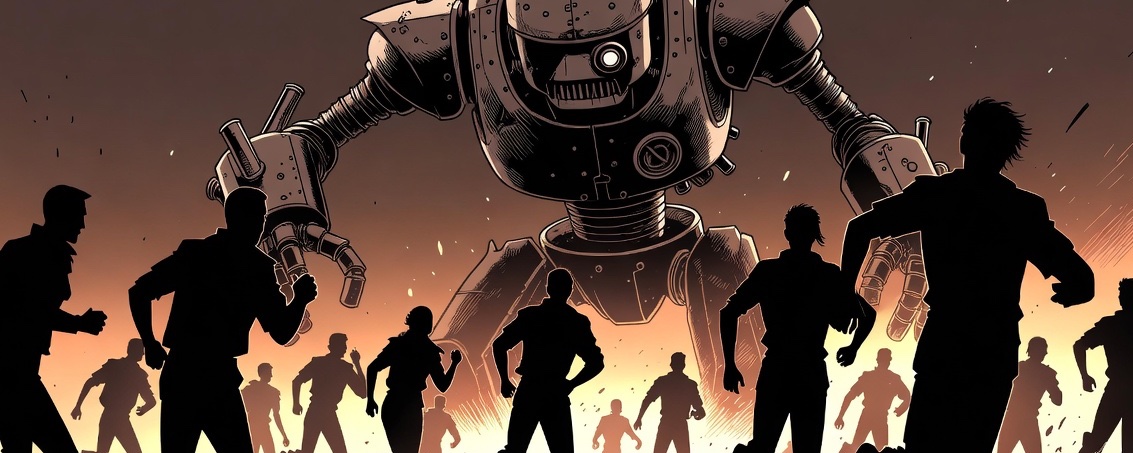
The scariest thing about AI isn’t that it might become a monster. It’s that it’s becoming an alibi.
Jeff Bezos has been making the rounds with a posture I understand—and still think is dangerously incomplete. He’s argued that people should be more excited than discouraged about AI, that the benefits will be “gigantic,” and that AI will raise quality and productivity across virtually every industry. He’s also described the current wave as an “industrial bubble,” where capital floods both good and bad ideas, but the underlying technology is real.
I agree with him on the technology. I disagree with him on the posture.
Because the biggest danger right now isn’t a Frankenstein monster coming to take your job. The danger is far more human: leadership carrying an illusion downstream, then asking ordinary people to pay for it with their dignity, their workload, and their trust in the future.
This is not an anti-AI argument. It’s anti-illusion.
What Jeff Bezos Gets Right—and What That Posture Misses
When Jeff Bezos says AI will boost quality and productivity across companies, he’s pointing at something real. Cognition is getting cheaper, faster, and more widely available. When he calls this moment an “industrial bubble,” he’s making a historically literate point: bubbles can overfund nonsense and still build infrastructure and capability that lasts.
But here’s the miss.
That optimism becomes corrosive when it’s translated into a management belief that because cognition is abundant, human agency is optional. And that belief is spreading—quietly, confidently—through boardrooms and executive decks, then shoved downstream into org charts as “efficiency.”
In other words: AI isn’t a monster. AI is a mirror and an amplifier.
It mirrors what leadership thinks value is. And it amplifies the consequences of being wrong.
The Actual Shift: From “Value Embedded in Outputs” to “Value Co-Created in Use”
Most organizations still run on an industrial-era assumption: value is created by the firm, embedded in outputs, and exchanged transactionally—produce → sell → done. This is classic Goods-Dominant logic.
But the world has been moving—slowly, then suddenly—toward a different reality: value is not embedded; it’s co-created in use, determined by the beneficiary, and shaped by context, relationships, and stakes. This is Service-Dominant logic.
Plain English:
G-D logic treats value like a thing you ship. S-D logic treats value like something that happens—between people, in context, under real conditions.
AI accelerates this shift brutally. When cognition becomes cheap, downstream execution—volume, repetition, pattern-matching—gets commoditized. What remains differentiating is live, contextual, relational co-creation.
That’s the hinge. And it’s why the current leadership posture is so dangerous.
The Illusion: “If Cognition Is Cheap, We Can Remove Humans”
Here’s the dream industry chased for decades: commoditize cognition, drive reasoning costs toward zero, treat humans as expensive overhead, and “embed value” in automated outputs.
In 2024–2025, they got a real taste of that dream. By early 2026, the regret is spreading—loud in public, quiet in budgets, unmistakable in rehiring.
The fatal mistake is not adopting AI. The fatal mistake is treating AI as a standalone operant that can fully replace human agency.
Because in Service-Dominant reality, the value moment is rarely the polished output. It’s the exception. The escalation. The emotionally loaded interaction. The accountability point. The place where someone has to own consequences under real stakes.
That cannot be fully delegated to silicon without brittleness, lost trust, and expensive boomerangs.
The Proof Pattern: Automation Wins on Volume, Loses on Trust
The loudest example is Klarna.
They celebrated an AI assistant handling a massive share of customer chats, framed it as the equivalent of hundreds of agents, cut headcount, paused hiring, and enjoyed the efficiency headlines.
Then came the reversal.
Customer satisfaction fell. Escalations looped. Empathy gaps widened. Trust eroded. Leadership admitted they went too far prioritizing cost over experience. They resumed hiring and shifted to a hybrid model: AI for routine volume, humans for nuance, complex reasoning, emotional repair, and relational depth.
That’s the entire story in miniature:
AI can be extraordinary at throughput. But when you remove human agency from the moments where customers determine value, you don’t get efficiency. You get a slow leak of trust.
And trust is the invisible balance sheet.
Once you see that, the “monster” framing looks childish. This isn’t sci-fi. It’s service economics.
The Rehire Wave Isn’t a Fluke. It’s the Invoice.
If you want to understand this moment, stop looking for Terminator stories and start watching labor boomerangs.
Companies that cut customer-service headcount “because of AI” are rehiring under new titles: AI orchestrator, escalation specialist, hybrid agent. Others are quietly restaffing at higher total cost than the savings they once celebrated.
The pattern repeats because the logic repeats.
Leadership clings to Goods-Dominant assumptions—value embedded in outputs, humans as replaceable operands—while AI pushes the economy harder into Service-Dominant reality, where operant resources like judgment, relationship, and intent are primary.
So the illusion doesn’t just misfire. It creates a predictable cycle:
-
- Automate to hit a cost target.
- Celebrate productivity on easy cases.
- Watch edge cases accumulate.
- Watch trust slip.
- Quietly rebuild the human layer you pretended you didn’t need.
That’s the AI regret story—not because AI is bad, but because the posture is wrong.
Where the Pain Gets Pushed Downstream
When leaders believe “AI will replace X,” the fastest way to make the spreadsheet look true is to remove humans from the very places where value is decided: escalations, exceptions, relational repair, judgment calls, accountability moments.
What follows isn’t just operational. It’s moral.
The illusion travels downstream in three ways:
-
- Humans become the mop crew for automated confidence. The system produces polished output; people absorb the fallout.
- Humans inherit trust debt. When customers feel dismissed or looped, trust doesn’t disappear—it gets handed to the next human who shows up.
- Humans get managed like accessories. Instead of designing hybrids that respect agency, people become the flexible patch layer: overworked, under-credited, blamed for systemic brittleness.
That’s the haunting. Not the technology. The posture.
The Alternative: Elevation, Not Elimination
The winners are already pivoting.
Humans move upstream as directors and orchestrators. AI operates downstream as an infinite amplifier. Pricing shifts from one-shot transactions to relational ecosystems. Organizations redesign around hybrid loops where humans own direction, ethics, and accountability.
Make it visceral:
-
- Humans decide what matters.
- AI accelerates what we decide.
- Humans own the consequences.
That’s the adult posture—not fear, not hype, but responsible leverage.
And it’s where Jeff Bezos—and the leaders borrowing his optimism—need to evolve. Optimism without a value theory becomes a permission slip for avoidable harm.
A Simple Leadership Test
Before automating another layer of human interaction, ask one question:
When the system fails—who absorbs the cost?
If the answer is “frontline humans,” you haven’t built an AI strategy. You’ve built a downstream suffering strategy.
A real AI strategy assigns accountability clearly:
-
- Humans set direction and boundaries.
- AI handles repeatable throughput.
- Humans handle exceptions, repair, and trust.
- Leadership owns consequences—explicitly.
That’s not romantic. It’s robust.
Closing
We don’t need more Frankenstein metaphors. We need clearer sight.
AI is not a creature. It’s not a will. It’s not a moral actor. It’s a tool that makes our assumptions executable at scale.
If your assumptions come from Goods-Dominant logic—value embedded in outputs, humans as overhead—AI will amplify that mistake until it shows up as trust loss, quality decay, and rehiring bills.
If your assumptions come from Service-Dominant reality—value co-created in use, agency respected, accountability owned—AI becomes what it should be: an extraordinary amplifier of human intent, not a replacement for human responsibility.
They got what they wanted. Regretted it fast.
Now the real transition begins: respect human operants, direct the tool, build hybrids that endure.
Posture. Timing. Partnership. Own what you hold.